






Resource
The Most Important Tank: The Hospital Tank
How to ensure that diseases don't make it into show tanks. Screening and treatment of potentially sick fish.
Quick answer
When you acquire a new fish, then the next step is the hospital tank.
Practical steps
- Aquisition of new stock
- Place fish into hospital tank
- Observe and treatement for the screening and confinement of disease
- After clearance, hospital tank has a new role
Photos
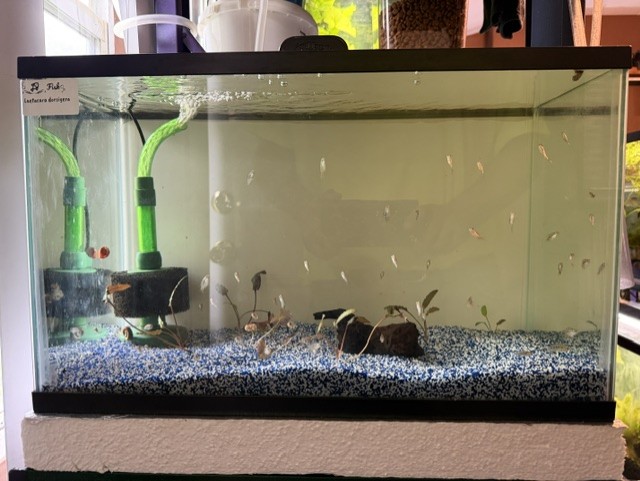
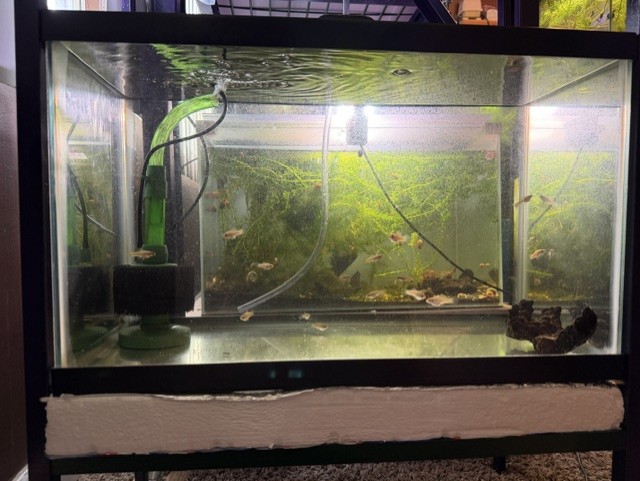
One of the most fundamentally debilitating and most consequential mistakes that people make who enter the hobby is only getting one tank. The reality is at a bare minimum every person entering the hobby needs a minimum of two tanks. What they need is the tank they envision, the tank they will proudly show to the world and use as their own slice of nature and the second one is a hidden one but this tank is going to do all of the heavy lifting. This tank makes the first possible and we in the hobby call it a hospital or a quarantine tank. At first the necessity of this tank is not immediately obvious. When people enter the hobby they think of picturesque landscapes and pristinely decorated aquascapes with a sea of movement as fish navigate their interiors. What they don’t envision is the work that must occur in stages for this to occur. Hospital or quarantine tanks ensure that the landscapes that you build do not have to be agonizingly torn down to retrieve sick fish and it denies pathogens the landscape of the primary tank to hide in. As hospital tanks are by design minimalist, they are easy to clean and easy to sterilize should the need arise. They ensure that aquascapes don’t have to be torn up and that fish area healthy before the fish are cleared to go to the actual show tank. The following is a discussion of the hospital tank or the quarantine tank and the various uses for it after the main tank has been stocked.
1.) The Quarantine Tank:
- The primary use for the Quarantine or the hospital tank is to screen new additions to your fish room or your show tank(s). When fish come to you, you trust that they are healthy and that they are free of disease. Sadly in the environments from which they come from before they enter the home aquaria this is rarely the case. Diseases can have outward expressions but more commonly and a great deal more insidiously disease spreads internally and in a manner that is not readily visible to the fish keeper. If a fish that is sick is released into the show tank two potential problems can occur. First the fish can spread the disease to the other inhabitants of the tank. Second the fish can die while inside of the tank and many pathogens upon death leave the fish and seek out a new fish to infect. Finally the fishes body can rot inside the show tank causing an excess in nutrients and allowing unsightly algae to bloom. Hospital tanks avoid all of this. Hospital tanks come in two flavors, bare bottoms with decorations and usually lightly decorated with sand. Please see the pictures below for an example of each. Bare bottom tanks are usually favored as hospital or quarantine tanks due to their ease of cleaning. These tanks are very easy to look at and go over with a siphon. Thereby vacuuming up parasites in the cyst phase or medicated and paralyzed parasites expelled by the fish’s body can be directly removed. They are not however universally ideal. Some fish require sandy bottoms, earth eaters famously sift through the sand consuming organic matter they find there. Coryodorus cats can also use sandy bottoms to look for food. Still others like the Kuhli loach of the peacock eel are most at home digging in sandy bottoms, covering their bodies, and sticking their heads out of the sand waiting for the opportunity to pounce on worms and other forms of live food that might come swimming by.
- Medications work in two ways. Some outright kill the pathogens that infect our fish. Others act as paralytics (which is a fancy way of saying they paralyze the pathogen). Paralyzed pathogens are not killed, they simply lose the ability to control their bodies and can thereby be expelled from the fish’s gastrointestinal track. The problem with the use of these medicines is three fold. First they are incredibly expensive and are titrated to a particular amount of gallons per dosage. Using a ten gallon tank as a hospital tank allows the hobbyist to keep the expense down and keeps us from spending a fortune in antibiotics/paralytics. The second problem with these medications is that they do not discriminate. They will sometimes kill on contact organisms that we don’t want them to kill. Thus if a hospital tank contains only sick fish, the medication goes towards killing the pathogens causing illness and doesn’t actually kill organisms such as live plants that the hobbyist is using to decorate the tanks. The third problem in the use of these medications is similar to the second in that the medication can kill the bacteria we rely on in the filter itself. As hobbyists we depend on Nitrosomas and Nitrobacter bacteria to help us convert ammonia to nitrate as the fish produce waste. These filters help us manage water conditions and keep the water from becoming toxic. The problem is that many of these medications do not differentiate between good bacteria and pathogen. Thus using these medications can have the unfortunate affect of killing life saving bacteria that cleanse the water and safely eliminates wastes. Thus keeping the medication confined to a bare bones hospital tank allows the aquarist to freely address problems without disrupting that balance that has already been created in the tank they are wanting to display. When the aquarist is confident that the livestock has been cleansed of the pathogen that had infected it, they can now add healthy stock into the main tank without fear of damaging what was already there.
2.) The Nursery Tank:
- There comes a point and time when the aquarist has completed their goals for a particular tank. Having fully stocked the tank to their initial goals and having created the community that they wanted to create they will now look to the quarantine tank and realize that there is nothing in it. Its tempting to instantly fill it but this is not a good long term plan. Its not a good long term plan because after many months of observing your tank you may begin to notice babies in the main tank. In a closed environment such as an aquarium, it can be next to impossible for baby fish to have the opportunity to grow to adulthood thus a hospital tank can now be employed as a refuge for raising the young fish that you find. Now it might not be immediately apparent as to why you would want to do this. However fish have individual lifespans just like people do. They are young, become adults, they breed, and they also can die. Some fulfill this lifecycle within the span of a year. Annual killifish are famous for this. Others such as African cichlids may take a decade or more to die of “old age.” Growing your own baby fish allows you to replace the fish that would have otherwise naturally depleted due to old age. It allows you to minimize the cost of needing to replace the fish you have lost and it also allows you the opportunity to return to a fish store and offer the fish you have bred back to them for store credit or if the store allows to sell the fish back to them for money. Returning with young fish can be a fantastic way to expand a fish room and manage your costs.
3.) Live Food Culture:
- Some hobbyists will live their entire life and not find this need. Indeed most hobbyists do not keep fish with special dietary requirements. Others who specialize in organism such as micropredators, leaf fish, or pufferfish will quickly learn that the aquarium inhabitant that is now under their care will readily eat them out of house and home. A way to minimize this cost is to grow your own. Luckily many of the live food options that we have available in the hobby can be grown in hospital tanks that are no longer needed for cleansing stock of diseases. Ramshorn snails and scuds are two examples that are commonly grown in live food tanks in the hobby and these are organisms that rather quickly replicate. They can then be used to nourish those fish that will only consume live food. If more then one hospital tank is kept, then these tanks when not needed to screen for disease can also serve as redundancies allowing for resiliency in food supply against sudden population crashes in these tanks.
4.) Fry Predator Housing & Rescreening:
- From time to time and especially when the use of live food is demanded by organisms it becomes necessary to once again treat the fish under your care. This is especially true if you’re keeping a predator that demands live fish. Many “feeder” fish that you can purchase at Petsmart, PetCo, and your LFS (local fish store) feature fish who are mass produced, life short lives that are packed so full that the sheer density of individuals almost guarantee the exposure of one or more pathogens. These pathogens can be transferred to the predatory fish when the “feeder” fish enters the tank. This is also true of livestock like the pufferfish that demand snails as a larger portion of their diet. These animals also tend to be exposed to pathogens that require yearly cleansing in order to prevent infection from becoming a problem that would threaten their health and well being.
- Finally it is possible with rather prolific species of fish to be put into a situation where the sheer speed of reproduction can be overwhelming and detrimental to not just the fish keeper’s ability to adequately care for the species but it can also yield gene combinations in the offspring that can be damaging to over all quality or fish health. When this occurs it is common for hobbyists who have become fish breeders to employ in their hospital tanks piscivores that can eliminate the deformed or undesirable fry. A common example of a fish that helps us ensure that only top quality and healthy fish are passed onto other hobbyists is the South American leaf fish. This fish is naturally a fry predator in the Amazon, its relatively small as it preys exclusively on fry sized live food in the wild and can be kept happily in tanks of 10 gallons. Hospital tanks that are no longer required to cleanse fish can also help us ensure that are costs are held down and our tanks are not overrun by providing us a place where unwanted fry are both humanely killed and consumed.