






Resource
Aquarium Cycling Basics
A simple note about getting a tank ready before adding fish.
Quick answer
Cycle the tank until it is stable before adding fish.
Practical steps
- Set up the filter, plants (if any), and substrate.
- Test ammonia, nitrite, and nitrate during the cycle.
- Wait for the tank to stabilize before adding fish.
Photos
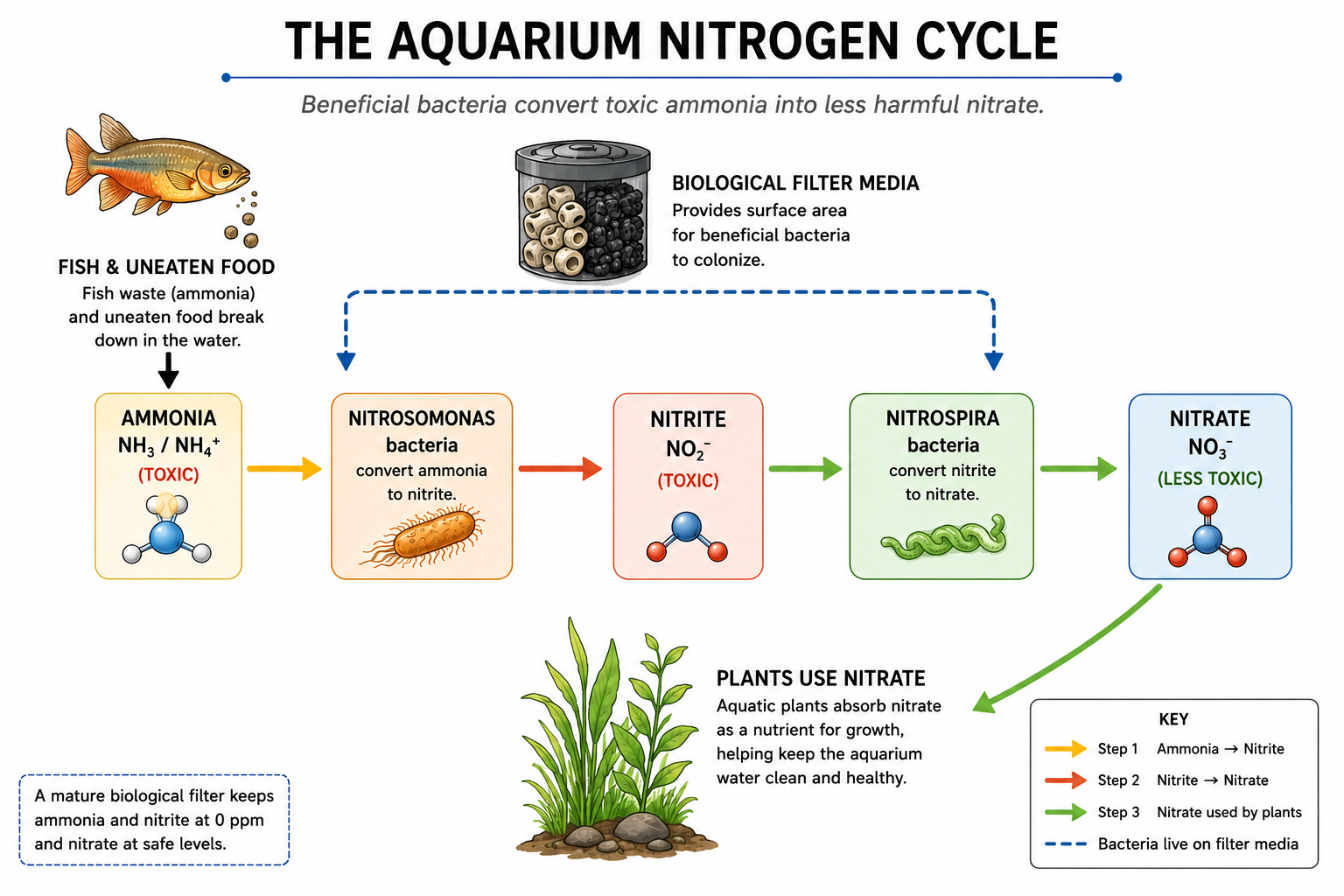
Cycling a new tank gives the filter bacteria time to grow so the aquarium can handle waste more reliably. There are many different methods to cycle a filter. These methods each have their strengths and each have their weaknesses. Though the method changes, the end result is always the same, the goal is to process the waste nearly instantaneously so that any waste produced can be converted to nitrite and then rapidly converted to nitrate. Here are some of the methods that have been traditionally used.
1.) Using Chemical or Existing Biological Media:
- The cheat method of cycling a new tank starts as all tanks do by setting up the tank as normal. The filter is selected. Usually this filter is either a sponge or a HoB (hang on the back). Then you use a product such as Fritz Zyme 7, ADA NATURE AQURIUM BACTER 100, or API Quickstart and you dose the tank as prescribed by the manufacturer into the aquarium. After 24 hours and once per day a small water change is done until ammonia reaches zero. The ammonia can be fed directly into the tank, through a sacrificial fish, or by taking a chunk of shrimp or similar meat and allowing it to breakdown into the tank.
- One variation on this method is to instead of purchasing the bacteria from a manufacturer, you take an already existing sponge filter or cannister and you squeeze it out into the new tank. You then wait 24 to 48 hours and begin cycling the aquarium using the bacteria from an already seeded filter. It should be noted that this is a a very quick way of cycling new filters. Like before either a sacrificial fish is introduced, or a chunk of meat can be added allowing it to breakdown in the tank and create ammonia for the bacteria to metabolize.
2.) Slow and steady:
- The slow and steady method of cycling tank starts as all tanks do by setting up the tank as normal. The filter is selected and started. Then you add either fish food, organic waste, or ammonia and then you wait. You will then wait and you will wait and you will wait. Weeks later, the filter should be established enough to process waste and to safely support fish. When you add the ammonia what you will see is a bacterial bloom. A bacterial bloom looks like a white or light brown haze in the tank that is the sign that the bacteria have recognized that nutrients are in the tank, and they are dividing rapidly. As this happens every few days you will notice if you have a test kit that the ammonia level will drop. As the ammonia level drops, the nitrite will start to rise. As more ammonia is generated, the filter develops more bacteria. Over the course of weeks the bacterial bloom will eventually clear up. The haze will disappear, the foul smell coming from the aquarium will clear up. This means that the filter has processed the excess nutrient load. A water change is commonly done and then fish are then slowly added.
3.) Cycle with Live Plants.
- This is my favored method of cycling a tank. I set up the tank as normal only the last decoration that I add will be a large amount of live plants. To aid the process I will use very quick growing stem plants such as anacharis or bacopa and then pair these stem plants up with a top water plant such as salvinia minima or frogbit. A used filter sponge is then squeezed into the tank. When the water clears a small amount of water 10% is removed. If the water starts to cloud up then it is allowed to clear. A fish is then placed in. This fish is there to begin eating food, begin pooping, and now my job as the hobbyist is to monitor ammonia levels. During this time you can see the proliferation of algae, the growth of plants, and this is fine as algae will also help us process the excess nutrients. As the first two weeks go by you exchange 10% of the water per day every other day. The week after should see strengthening of the filter. The result of which is water changes will be needed less and less. Every three days afterwards is a water change is done. Finally the tank is put into the same rotation as the rest of the tanks and fish are added a little at a time until the final stocking levels are achieved. Using this method is actually very quick it is exceedingly rare to detect ammonia after the second week. The ammonia as well as the nitrite can be utilized by plants and incorporated into their tissues.
Finally its worth noting that nitrifying bacteria grows on all surfaces found in aquariums. As aquariums age, they end up building up redundancy in bacterial colonies across all surfaces. The longer the age of the aquarium the more it will be able to accommodate increased bacterial loads.
Related content