






Resource
Plants & Nutrient Deficiency Diagnosis
Aquarium plants have a lot to tell us about the flow of nutrients in our aquarium ecosystems. Careful observation of these plants can tell us about he metabolic rate of absorption of these plants, what nutrients are present, and most importantly what nutrients our tanks may be deficient in.
Quick answer
Plants can tell us a lot about the availability of nutrients in our aquarium ecosystems. This article will help us identify when nutrients are in excess, when nutrients are deficient and nuisance algae's proliferate, this article will address what you can do to overcome this.
Photos
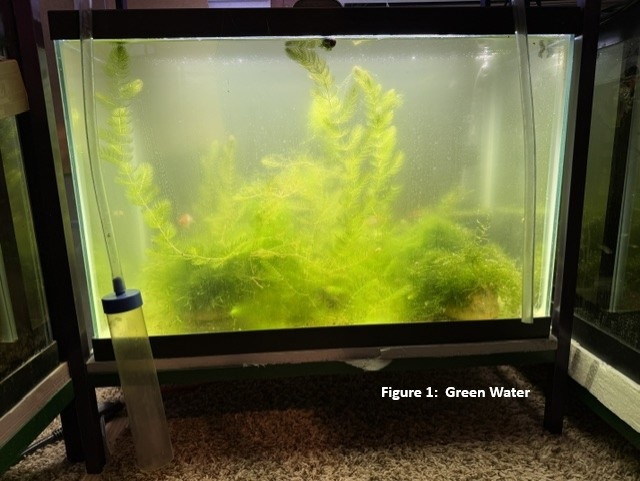
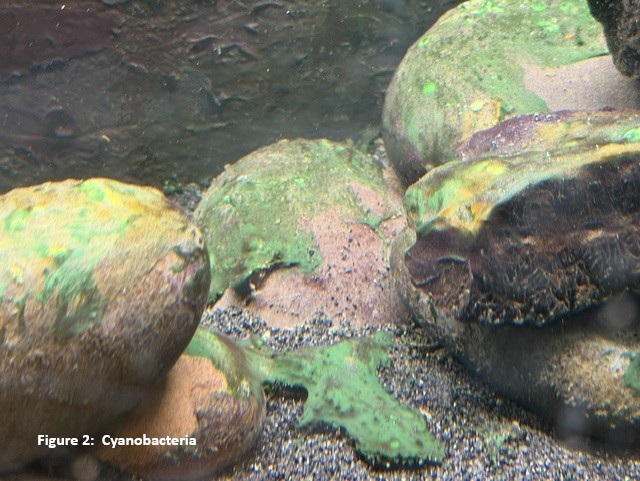
Hobbyists are ecosystem engineers. The ecosystems that we manage are the environments that both our plants and animals live in. One of the most difficult aspects that we must aware of and manage involves something we can never truly see and something that we can’t directly be aware of, the nutrient levels inside of our aquarium ecosystems. To some the answer is simply blind dosing with sometimes very expensive fertilizers. The problem of course with the blind dosing of fertilizers becomes most readily apparent when all of a sudden green water (Figure 1), cyanobacteria (Figure 2), and nuisance algae begins to bloom because instead of being deficiency now the nutrient level far exceed that which the plants themselves can take up. Thus it would be nice if we could develop the expertise to recognize deficiency when it exists so that the fertilizers that we use can be used at the appropriate times, to address a legitimate need, and can be safely used without overdosing. This article will help you make direct observations that will help you detect deficiencies focusing entirely upon plants. It is important to note that in this article we are going to assume that the plants that the hobbyist are using are in fact fully acclimatized to the water. It should be noted that this is not always the case especially when newly purchased. Many plants that are newly purchased are grown above the water. When immersed they melt and die.
When the rate of nutrient uptake is insufficient to the rate at which it is being generated in the tank or when there are excess nutrients in the system, the net result is still the same. The net result is the proliferation of nuisance organisms that are considered undesirable, unsightly and even destructive by most aquarists. When the nutrients exceed the capacity of the plants to take it up and lock it in the system we see other opportunists begin to proliferate. Organisms such as green water, cyanobacteria and algae are the canaries in the coal mine that tell us immediately that the nutrients in the system exceed the capacity that the plants in our tank can lock up and absorb. Thus when they are proliferating and the plants are not, this is a clear warning sign to the hobbyist of a dire issue ahead that must be addressed. How one addresses this issue can be as simple as turning on a carbon reactor for the case of heavily planted tanks that are experiencing cyanobacteria and algae proliferation. The increased CO2 acts as a supercharging nutrient that stimulates plant growth and accelerates their metabolism increasing eating up the available nutrients in the tank and locking it into plant matter. If your tank is fairly bare and suffering from green water as in Figure A, using a UV sterilizer to eliminate the organism and clear the water is a very viable solution to the issue. Another thing that can be done either concurrently or independently to combat low uptake of nutrients is to eliminate the excess nutrients through water changes. This is usually a temporary fix but it is something that can immediately help in the short term. Finally when there are insufficient plant material to adequately metabolize the excess nutrients in the tank, another solid step to take is to increase the amount of plants in that tank. Increasing the physical number of plants is a great way to address the rate of metabolic uptake of nutrients. Just make certain that the plants that you add have been screened for disease and pests, and have been grown underwater. This is important again because plants are grown outside of the water tend to melt when placed underwater and grown. Obviously plants that die b ack would add to the nutrient load not take away from it.
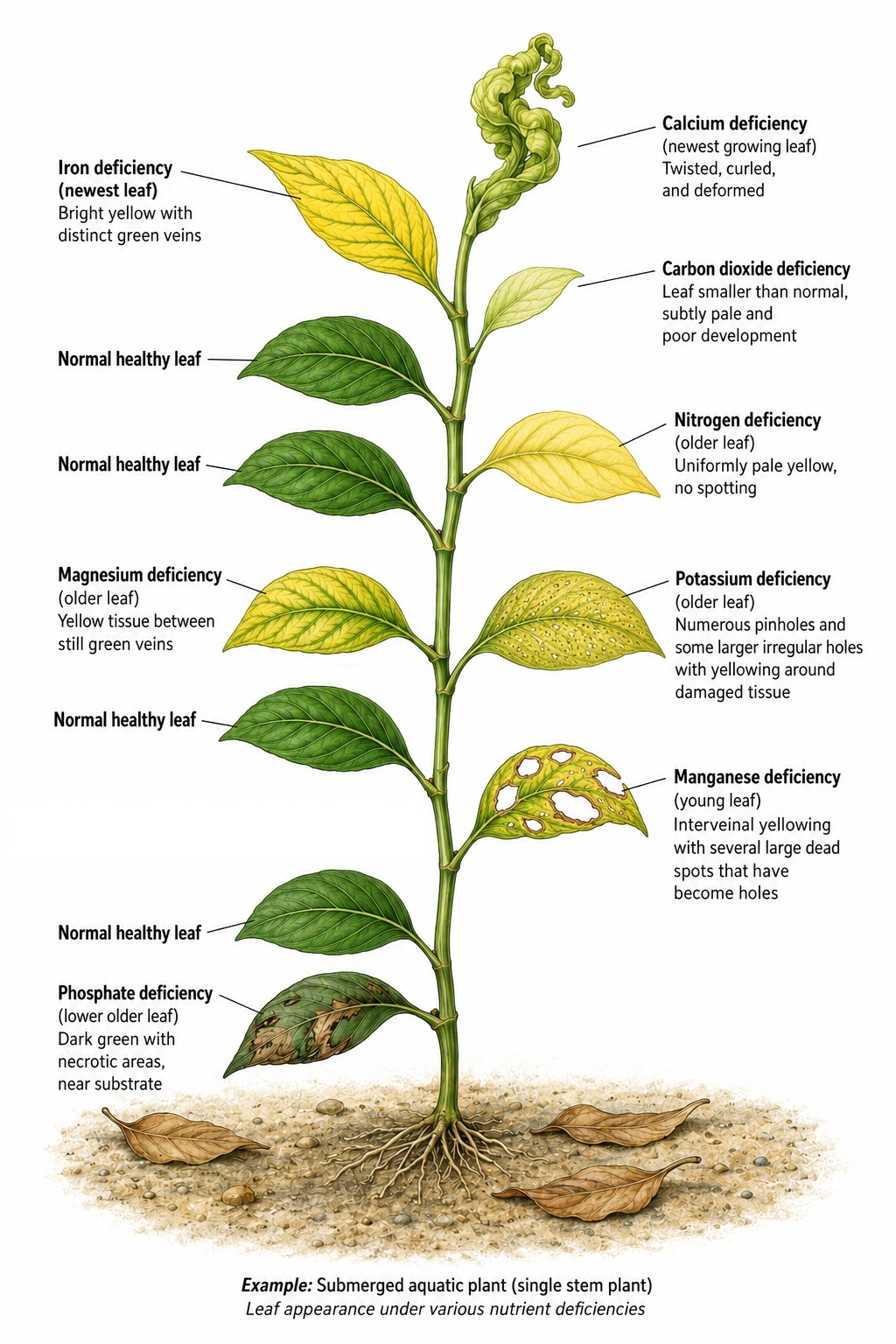
When the rate of nutrients in the system is insufficient to support the plant life in the tank, there are many observational indicators that things are in fact going wrong. In each case careful observation of plants and the trends that they are showing you can help you diagnose deficiencies so that you can dose with a fertilizer to reverse the limiting factor upon your healthy plant growth and its ability to metabolize the nutrients in the system. The first type of nutrient deficiency that we will discuss is a calcium deficiency. Calcium deficiencies are often easy to diagnose in plants that are putting out new leaves. These new leaves often demonstrate deformities. These deformities usually exist in misshapen, stunted leaves that are sometimes left in a twisted or wrinkled overall appearance. Plants get their green appearance from the presence of a molecule called chlorophyl. Chlorophyl requires iron in order for the plant cells to build it properly. Thus in a deficiency of iron, chlorophyl can’t be made by the cells as a result the leaves begin to turn yellow while the veins that are priorities by the plant for their structural nature usually retain their green appearance. Potassium deficiency in plants can cause pinhole sized holes to develop in the leaf tissue. The edges then being to turn yellow and brown and this will be followed by “melting” leaf tissue. Nitrogen deficiency in plants result in the yellowing of leaves. Additionally the leaves are usually smaller and sometimes tiny in form due to the lack of the nitrogen needed to build the ammino acids in its tissues. Phosphate deficiency can be very hard to spot in the modern aquariums. Usually fish foods and fish waste has more then enough phosphate for plants to avoid this symptom but there are times when chemical agents can be used to absorb the phosphorous in the water. When a phosphate deficiency is encountered, plant growth slows down Older leaves can become darker and be prematurely shed while younger leaves can see green spot algae growing on their surfaces. Like Nitrogen, phosphate is a vital nutrient for plant growth thus when plants are trimmed, they are very slow to recover when they have a phosphate deficiency. A magnesium deficiency occurs in stages. Yellowing usually starts in the older leaves from the end and starts to creep upward toward the veins. A manganese deficiency looks very similar to a potassium deficiency in that yellowing between the leaves lead to pin holes that being to form and elongate. These spots intensify, get larger, as the deficiency gets worse. Finally over longer periods of time a manganese deficiency results in a plant that beings to look stunted or miniaturized.
Now that we know what to look for, what can be done. Well luckily for us there are some very good products on the market that can help us in addressing deficiencies in the nutrients in our aquarium ecosystems. One of the very best products on the market at this time is made by Aquarium Co op called Easy Green. They advertise this as an all in one fertilizer. A quick look at its ingredients shows that it does cover nutrients like potassium, phosphate, nitrogen, magnesium, manganese and iron. Its easy to use coming with a dosing cup and a squirt bottle that allows the aquarist to easily administer the fertilizer to the tank. In my experience however this fertilizer while more then sufficient for most nutrients, really does not cover the entire need for potassium in our aquarium systems. The manufacturer Aquarium Co op seems to recognize this as well for plants like Anubis which seems to really require it and they also sell a supplemental fertilizer called Easy Potassium. When used in combination, these fertilizers along with supplemental CO2 can greatly increase the metabolic uptake of nutrients from our aquarium ecosystems and lock up the nutrients that can otherwise cause nuisance organisms to proliferate.